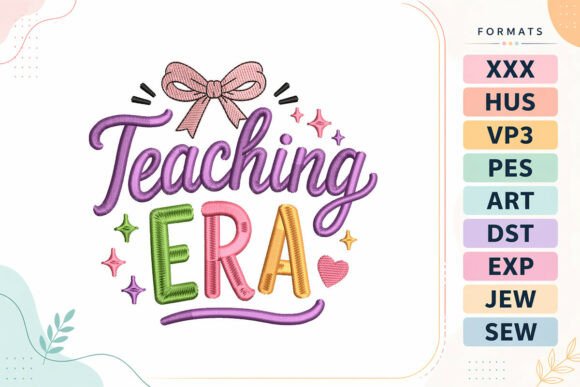
Teaching Era Back to School
A Designer’s First Look: Playful, Warm, and Instantly Recognizable
When I opened the Teaching Era Back to School machine embroidery design for the first time, what struck me wasn’t just the bright color palette—it was the emotional resonance. This isn’t just another teacher-themed embroidery file. It feels like a handwritten note from a beloved educator: cheerful, intentional, and full of quiet pride. The playful lettering carries rhythm and bounce, the sparkles aren’t overly dense (so they won’t snag or flatten), the hearts are rounded and soft—not cartoonish—and that bow accent? Delightfully dimensional without demanding excessive stitch density. It reads as modern but not cold, sweet but not saccharine—perfect for customers seeking handmade charm with contemporary appeal.
Where This Design Truly Shines: Real-World Personalized Gift Applications
I tested Teaching Era Back to School across six common personalized gift categories—and it performed beautifully in nearly all. On a 100% cotton baby blanket? Yes. The lettering stayed crisp, the bow added tactile interest, and the hearts read as tender rather than cutesy. As a custom embroidered towel for a new teacher’s kitchen? Absolutely. The design scaled well on terry cloth when paired with medium-weight cutaway stabilizer and slightly reduced top tension. For pillow covers and nursery wall hangings, it brought instant warmth and thematic cohesion—especially alongside chalkboard-style fonts or muted pastel thread palettes.
Etsy sellers and small shop owners will appreciate how naturally this design supports storytelling in product listings. Pair it with a photo of a handmade tote bag featuring Teaching Era Back to School stitched near the pocket, and you’re not selling fabric—you’re selling “the first-day-of-school confidence boost.” Wedding gift designers can reinterpret it thoughtfully too: imagine it stitched in ivory thread on a linen tea towel gifted to a newlywed teacher couple—or subtly resized and placed inside a quilted wedding keepsake box liner. Even baby embroidery projects benefit: when stitched onto a muslin swaddle with gentle pastel threads, it becomes a meaningful nod to a parent’s profession—not just decoration.
Smart Placement & Fabric Considerations
That said, Teaching Era Back to School isn’t universally forgiving—and that’s okay. Its charm lies in balance, not brute-force versatility. Avoid using it on highly textured fabrics like heavy bouclé or thick waffle-weave towels unless you pre-test stabilizer layers (I recommend tear-away + light cutaway combo). Skip stretchy baby onesies entirely—the bow and fine lettering details risk distortion during hooping and wear. Curved surfaces (like mugs or curved tote straps) require careful digitizing adjustments not included in the base file, so stick to flat or gently contoured items like pillow covers, aprons, and flat-front totes.
Dark fabric demands attention: those sparkles and fine outlines need high-contrast thread colors to remain legible. I ran side-by-side mockups on navy and heather gray towels—using bright white and pale gold threads—and confirmed readability only held up when stitch density allowed clean separation between elements. Also, avoid shrinking the design below ~3.5 inches wide. At smaller sizes, the bow loses definition and the heart spacing tightens unnaturally. Always confirm your intended hoop size before digitizing adjustments—this design works best in 4x4 and 5x7 hoops.
Why It Elevates Your Handmade Product—Beyond Aesthetics
As a designer who ships hundreds of custom embroidery orders yearly, I’ve learned that perceived value isn’t just about stitch count—it’s about emotional alignment. Teaching Era Back to School taps into something genuine: respect for educators, nostalgia for classroom joy, and celebration of personal milestones. Customers don’t just buy a personalized gift—they buy recognition. That translates directly to higher average order value, stronger repeat engagement, and more organic social shares (especially from teachers themselves tagging their shops).
Photography benefits too. The design’s balanced composition and built-in visual hierarchy (bow as focal point, lettering as anchor, sparkles as texture) make it easy to style. No cluttered backgrounds needed—just lay it on a sunlit windowsill beside a coffee mug and open textbook. That authenticity builds trust faster than any polished studio shot. For Etsy sellers, that means better click-through rates and improved search visibility for terms like “teacher birthday gift,” “personalized educator present,” or “back to school baby blanket.”
Essential Embroidery Notes Before You Stitch
- Always test on scrap fabric matching your final product’s weight, weave, and stretch—even if you’ve used this design before.
- Check thread color contrast early: print a digital embroidery file mockup on both light and dark fabric swatches to preview legibility.
- Review stitch density visually—if sparkles appear muddy or lettering looks fused, reduce density slightly or adjust underlay in your editing software.
- Use appropriate stabilizer: lightweight cutaway for knits, tear-away for stable cottons, and fusible + cutaway for terrycloth or textured weaves.
- Confirm commercial licensing terms before listing finished products—Teaching Era Back to School is intended for commercial embroidery, but verify usage rights for resale.
- Inspect small details post-stitch: hearts should be symmetrical, bow loops distinct, and letter spacing even—especially after washing tests.
Final Thought: A Thoughtful Choice for Meaningful Makes
Teaching Era Back to School isn’t just timely—it’s timeless in its intention. It bridges the Back To School season with year-round relevance for teachers, parents, graduates, and lifelong learners. Whether you’re stitching baby embroidery for a newborn whose mom teaches kindergarten, curating wedding gifts for education-sector couples, or building a signature line of custom embroidery for your Etsy shop, this design invites connection. It reminds us that behind every personalized gift is a story waiting to be stitched—thoughtfully, proudly, and with care.